SRDC's PACE financing program helps local producers make long-term energy investments
For southwest Minnesota farmer Justin Opdahl, investing in solar energy was about more than installing panels and reducing an electric bill. It was an opportunity to take control of rising operating costs, invest in the future of his family's farming operation, and put his experience in the renewable energy industry to work closer to home.
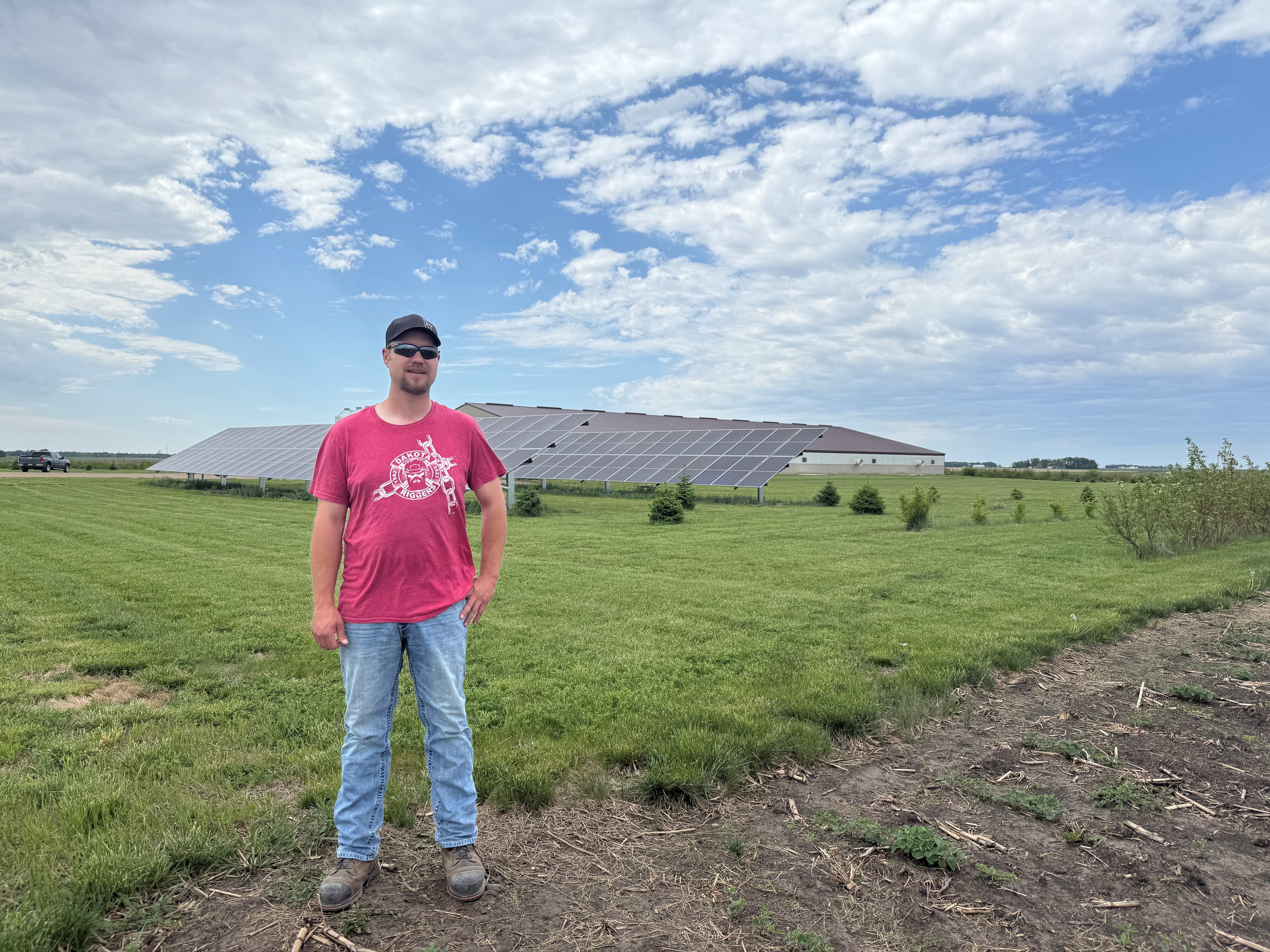
Justin and his brother, Garrett Opdahl, jointly own a hog barn in southwest Minnesota. In addition to the hog operation, Justin raises stock cows and farms a small amount of cropland. Like many livestock producers, the brothers face ongoing expenses associated with operating their facilities, including the electricity needed to power ventilation fans and other equipment.
With energy costs continuing to rise, Justin began exploring whether solar energy could provide a practical, long-term solution.
Today, with assistance from the Southwest Regional Development Commission (SRDC) and financing through the Property Assessed Clean Energy (PACE) program, that idea has become a reality.
From an Idea to an Investment
Justin's interest in solar energy began approximately four years ago when he came across an advertisement on Facebook highlighting the potential benefits of solar installations.
The idea immediately caught his attention, and he contacted the company to request an estimate. However, the initial price made him question whether the investment would make financial sense.
"It was expensive, and I didn't know if it was going to pencil out," Justin recalled.
By 2024, Justin noticed more solar installations appearing throughout the region and decided to take another look. This time, he discovered an opportunity to apply for grant funding that could cover approximately half of the project's cost.
He applied and was awarded the grant, making the investment much more feasible.
"Without the grant, it wouldn't really be worth it, to be honest," he said.
Justin also brought a unique perspective to the project. For approximately 17 years, he has worked in the wind energy industry and currently serves as a site supervisor, assisting with repairs, maintenance, and major component replacements. His experience gave him an appreciation for renewable energy and its potential benefits.
"I kind of have my heart in renewable energy a little bit," he said.
Combined with the opportunity to reduce future electricity expenses, the financial assistance helped convince him to move forward.
SRDC and PACE Help Bring the Project Together
While grant funding helped reduce the overall cost, financing the remaining investment was another important piece of the project.
That is where SRDC and the PACE program entered the picture.
Justin first learned about PACE through his banker, Ben Lutterman of Chandler, who had attended a meeting where he connected with SRDC Deputy Director Robin Weis.
After learning more about the program, Lutterman recognized that PACE financing could be a good fit for the Opdahls' solar project.
"He was at a meeting and ran across Robin Weis," Justin explained. "He heard about it and thought this PACE loan would be a really good idea to tie things together."
Lutterman helped coordinate the financing process, working with Weis and SRDC to explore the opportunity.
"Thankfully, Ben did a lot of the legwork for me and was in contact with Robin," Justin said.
The PACE program provides a financing option for eligible energy efficiency and renewable energy improvements. Rather than relying solely on conventional financing, participating property owners repay the investment through a special assessment collected with their property taxes.
For Justin, that repayment structure initially raised some questions.
"Honestly, I was a little worried about the biannual payment because it's tied in with our property taxes," he said.
However, after experiencing the process, his perspective changed.
"Now looking back, that's kind of actually nice," Justin said. "It allows some gap there to make sure I'm going to have enough electricity produced to cover this or that. I like it."
The repayment structure, combined with grant assistance and the potential for energy savings, helped make the investment manageable.
For SRDC, projects like the Opdahls' illustrate how regional partnerships and creative financing tools can help agricultural operations explore improvements that may otherwise be difficult to finance.
Overcoming Challenges Along the Way
The Opdahls' solar installation was originally expected to begin in fall 2024, but scheduling delays pushed construction into the following year. The project was completed in June 2025.
Although the installation marked an important milestone, Justin's experience also included unexpected challenges.
Shortly after completing the project, the installation contractor went out of business. When problems developed with the solar equipment, Justin found himself navigating warranty questions, troubleshooting issues, and working to find someone who could help restore the system's performance.
Drawing on his electrical and maintenance experience from the wind industry, Justin took an active role in resolving the problems.
"I actually did a lot of the work myself," he said. "I'm pretty familiar with electrical work. I work on wind towers, so I went online, did some research, and got it."
With additional assistance from the equipment supplier, the major operational issues were resolved by late March 2026.
While the system is now generating electricity, Justin is still awaiting warranty components that will allow him to access its full monitoring capabilities, including detailed daily production information.
The experience was not always easy.
"I kind of had a roller coaster of emotions over the whole thing," he acknowledged.
Nevertheless, with the major issues resolved, Justin is beginning to see the financial benefits he originally envisioned.
Energy Savings Making a Difference
Electricity represents an important operating expense for hog facilities, particularly when ventilation fans and other equipment are running regularly.
Justin estimates that the solar installation is now offsetting approximately 90 percent of the hog barn's electricity needs, although he emphasizes that the figure is an estimate based on the system's recent performance.
The difference is already showing up in his monthly utility bills.
When the solar system was experiencing problems, Justin reported receiving electric bills of approximately $300 to $400 per month.
More recently, with the system functioning properly, his bills have been closer to $100.
Although some utility charges remain for electrical service and use of the distribution system, the reduction represents meaningful savings for the operation.
Justin can review monthly electricity production and consumption through his utility bill and looks forward to having more detailed monitoring information once the remaining equipment issues are resolved.
For him, understanding the system's performance is part of the appeal.
He is especially interested in seeing how weather conditions and seasonal changes affect production throughout the year.
The installation uses fixed solar panels rather than a tracking system that follows the sun. Drawing on his experience maintaining wind turbines, Justin intentionally favored a system with fewer moving components.
"The more moving parts you have, the more problems you're going to have," he explained.
Looking Beyond Today's Savings
While lower monthly electric bills are an immediate benefit, Justin views the investment as a long-term strategy for the hog operation.
The system carries an approximately 25-year warranty, and Justin hopes the savings will continue well beyond the financing repayment period.
"The way I look at it, in 10 years, I won't have much of an electricity bill, if any. That's my goal," he said.
He also believes the installation could enhance the property's appeal if the operation were ever sold.
"If I was a buyer, I'd think that would be an extra added bonus," he said.
The project has attracted attention from other area producers as well. Since the installation, Justin has received several calls from farmers interested in learning more about the system and the process involved.
He has shared information and contacts with those considering similar investments, although he cautions that solar may not be the right fit for every operation.
His advice is to research the options carefully, understand the costs and potential savings, and explore available financing and grant opportunities before making a decision.
"Make sure you check out all of the possibilities," he said.
Despite the challenges along the way, Justin says he would recommend the PACE program to other farmers considering renewable energy projects.
Supporting Investment in Southwest Minnesota
The Opdahls' project demonstrates how local lenders, regional development organizations, and property owners can work together to make energy improvements possible.
Through its involvement with the PACE program, SRDC helps connect eligible property owners with financing opportunities for projects that can reduce energy expenses, improve operational efficiency, and support long-term financial planning.
For agricultural operations, where operating costs can significantly influence profitability, these investments can provide an opportunity to manage future expenses while improving existing facilities.
Justin's experience also illustrates that successful projects require more than equipment. Access to financing, knowledgeable partners, available incentives, and a willingness to work through unexpected challenges all play important roles.
For the Opdahls, the result is a hog facility with the potential to generate substantial electricity savings for years to come.
And for other southwest Minnesota agricultural producers and businesses exploring their own energy improvements, the project provides a practical example of how SRDC and PACE financing can help turn an idea into a long-term investment.
Learn more about PACE financing: Property owners and businesses interested in energy efficiency or renewable energy improvements can contact the Southwest Regional Development Commission at 507-836-8547 or visit www.swrdc.org to learn more about available financing opportunities.